I was flying from snowy Uzbekistan to a country where winter exists only as an abstract concept. The journey began long before the impressions I was heading for at the Diriyah Biennale.
As it turned out, a direct flight from Tashkent to Riyadh simply did not exist — at least not in my version of reality. Aviasales offered several options with connections: via Istanbul, Sharjah, or Jeddah. As someone who appreciates order, I chose a single airline and a familiar airport for the transfer — Istanbul. Three years ago, I had already flown this route on my way to Germany, to Frankfurt. So TURKISH AIRLINES did not appear in my story for the first time, and the journey itself already felt like the beginning of a good travel story with a deliberately complex plot.
Five hours to Istanbul and four hours to Riyadh — a plan that seemed perfectly logical until the moment I realized my main mistake: I had allowed only one hour and twenty minutes for the transfer, which in reality turned into five hours of waiting in the transit airport. As it turned out, optimism is not always the same as strategic thinking.
Before departure in Tashkent, snow was falling heavily. My family wrote with concern: “Are you sure the plane will even take off?” The airport was busy, flights were departing according to schedule, yet our departure was still delayed. For the first time in my life, I watched something that looked almost like a performance called “de-icing.” The aircraft was first generously sprayed with a yellow liquid, then with a pink one. This is done to remove ice and prevent it from forming again — otherwise the takeoff would be unsafe. From the outside, however, it all looked as if the plane was being prepared not for a flight, but for an art installation.
The delay exceeded an hour, and I began to map out possible scenarios in my head. The thought that I might miss my next flight in Istanbul stopped being a hypothesis and began to feel like an almost inevitable fact. One thing reassured me: both flights were operated by the same airline. I had downloaded the Turkish Airlines app in advance, and while still in the air I received a notification that my next flight had been automatically moved five hours later. The universe, at least at that stage, decided not to complicate the plot. I had also downloaded the King Khalid Airport (RUH) app — $0.99 was charged from my account — but for some reason I couldn’t use it. It only started working after I had already returned home.
At Istanbul Airport, I quickly realized I wasn’t the only one. At the international transfer desk, there was another passenger from our flight with the same fate. I was issued a new boarding pass and a meal voucher. I took a photo of the list of places where the voucher could actually be used. A hotel was not offered, but, to be honest, the airport itself turned out to be a fairly self-sufficient world — with restaurants and workspaces.
I had installed the Istanbul Airport app in advance — and it turned out to be one of the best decisions of the trip. Internet access was also well planned: back at Tashkent Airport, I bought two eSIMs from Happytel — one for Turkey and one for Saudi Arabia. It cost 250,000 soums, but in return I had peace of mind, navigation, and the ability to immediately message home that everything was fine and the journey was continuing. At the same time, the magazine issue was being finalized, so I had to open large files and work прямо from the terminal.
The power bank, by the way, turned out to be unnecessary — power outlets were literally everywhere in the airport. There was even a lounge area with reclining chairs for resting, though no free spots were available. Some passengers were sleeping прямо on the carpet, and the waiting area began to resemble a spontaneous camping site.
Before boarding at the gate, an airline employee approached me and asked to see my visa. I had arranged the Saudi visa online in advance: a form, payment, a short wait — and the approval arrived by email. I printed it out, as many travel guides recommend, and for good reason: the visa was checked and a note was made on my boarding pass. Back in Tashkent, I had also thoughtfully put on a long robe-style dress over my jeans and brought a sheila with me to cover my head if necessary. It turned out to be useful.
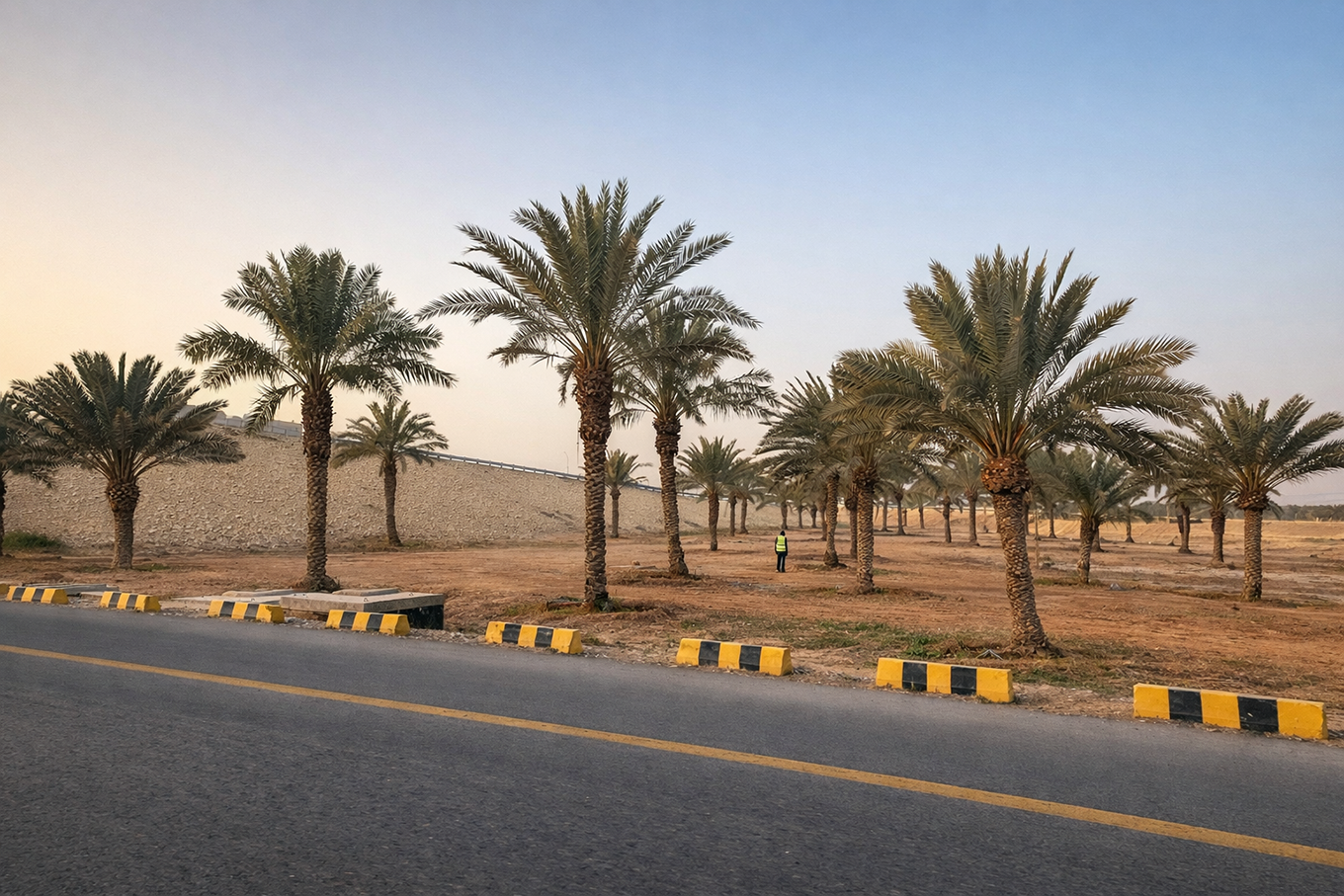
We arrived in Riyadh early in the morning. Passport control was quick: no one asked for the visa anymore — they only took fingerprints. And here, according to all the rules of the genre, came the final twist: I did not see my suitcase on the baggage carousel. Apparently, it had either arrived before me or decided to continue the journey on its own. Only another girl and I remained by the belt. We went to the baggage service desk and were directed to the opposite end of the hall, where I filed a report. They promised the luggage would be found by midday. For a moment, I imagined the scenario of a “biennale without a suitcase” and, already on the move, began thinking about how I would assemble an outfit for the first event while heading toward the transfer at the exit.
The biennale’s general partner was Lexus, so a comfortable car was waiting for me at the exit. After all the travel adventures, it felt like a return to stability: the route was once again clear, and it was as if you were standing on solid ground again. The coordinator approached immediately — he had been in touch with me since the moment I landed.
Just five minutes later, a WhatsApp message arrived: “Your luggage has been found.” The message included photos of my orange suitcase cover — instantly familiar and reassuring. So I headed to the Radisson Blu Hotel & Convention Center already reunited with my suitcase. Radisson Hotel Group, one of the biennale’s partners, was hosting guests at full capacity — the hotel was filled with journalists, more than a hundred of them.
At that point, it became clear: if the journey had already been so eventful, what lay ahead could only be even more interesting.